

There is an unspoken confusion in the global trade and logistics industry that few acknowledge and even fewer address.. We often use the words education, learning, and training as if they describe the same thing.. They do not..
The industry’s struggle with capability gaps, documentation errors, and operational inefficiencies can be traced back to this misunderstanding..
In a world where cargo moves across borders at digital speed, where regulations evolve without warning, and where technology reshapes workflows overnight, competence has become the most valuable asset in global trade..
Infrastructure may connect markets, systems may capture data, and platforms may automate tasks, but none of these work without people who know what to do, why it matters, and how to do it correctly..
Capability is the new currency of global competitiveness.. To understand how it is created, we must separate three concepts that are often, and incorrectly, treated as identical..
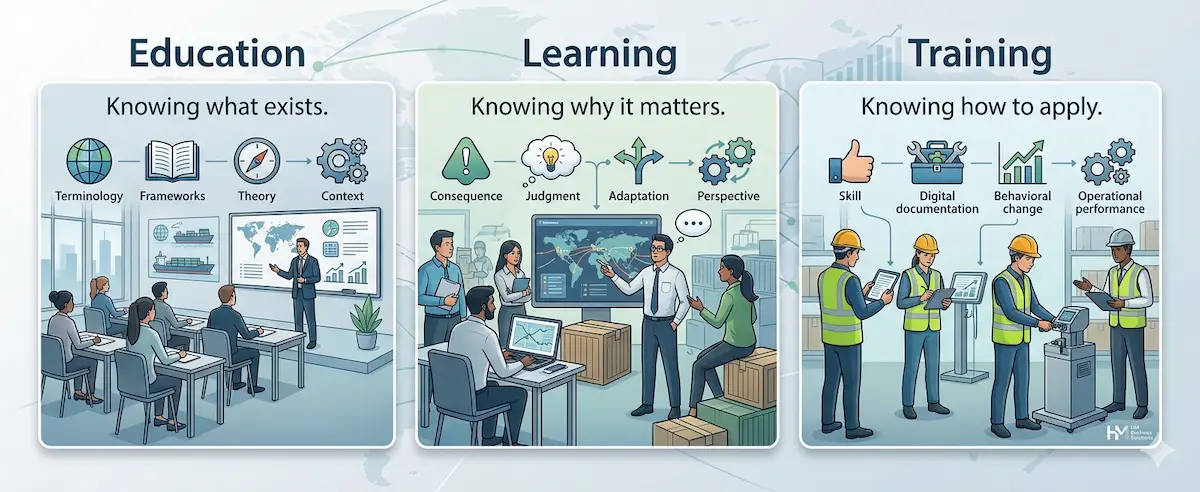
Education: Knowing what exists
Education is the foundation.. It is structured, formal, and content driven.. It explains what trade documentation is, how Incoterms influence cost and risk, why vessels call specific ports, and how customs and compliance frameworks govern the movement of goods..
Education provides:
- terminology
- frameworks
- theory
- context
It tells you what the rules are and where the boundaries lie.. Without education, individuals operate on assumption and organisations build processes on instinct..
However, education alone does not create capability.. It tells you what to do, but not how to respond when the real world refuses to behave like the textbook..
Learning: Knowing why it matters
Learning begins where education ends.. It is personal, experiential, and often unplanned.. Learning is what happens when a shipment misses a sailing because cut off times were misinterpreted, when a certificate of origin delays cargo release, when a tariff code creates unbudgeted cost, or when a digital document fails validation in a system you thought you understood..
Learning teaches:
- consequence
- judgement
- adaptation
- perspective
It transforms information into understanding and transforms employees into thinkers rather than task executors.. Learning is not an event, it is a process.. It happens in operations, not in classrooms..
Individuals who stop learning become outdated, even if they hold impressive qualifications.. Organisations that stop learning become inefficient, even if they adopt expensive technology.. In a sector defined by volatility and compliance demands, learning is the engine of relevance..
Training: Knowing how to apply
Training is where education and learning converge.. It is the deliberate transformation of information and experience into consistent, repeatable capability.. Training is intentional, structured, and outcome driven.. It does not merely tell you what should happen, it ensures you can make it happen..
Training produces:
- skill
- confidence
- behavioural change
- operational performance
It equips people to execute procedures correctly, complete documentation accurately, navigate digital tools effectively, and prevent avoidable errors.. Training turns knowledge into action and action into results.. It is not a workshop or certification, it is organisational muscle..
If education is the blueprint and learning is the apprenticeship, training is the construction.. It is the point at which competence becomes capability..
Why the distinction matters
Education, learning, and training may sound similar, but they produce very different outcomes.. For individuals, capability is what separates qualified professionals from effective ones..
It turns knowledge into confidence and career opportunity.. For organisations, capability protects margins, prevents compliance failures, and ensures processes work as intended.. Without it, technology becomes a liability rather than an advantage..
In a fast moving global trade environment, capability is no longer optional.. It is the difference between doing the work and doing it correctly..
Education tells you what to do.. Learning explains why it matters.. Training ensures you can do it well.. Capability is the result..
Turn knowledge into capability
HM Business Solutions helps organisations and professionals bridge the gap between knowing and executing.. We strengthen documentation processes, align people with systems, and ensure that the knowledge in your business translates into confident, compliant, and consistent action..
Contact us today to find out more..


Leave a Reply