

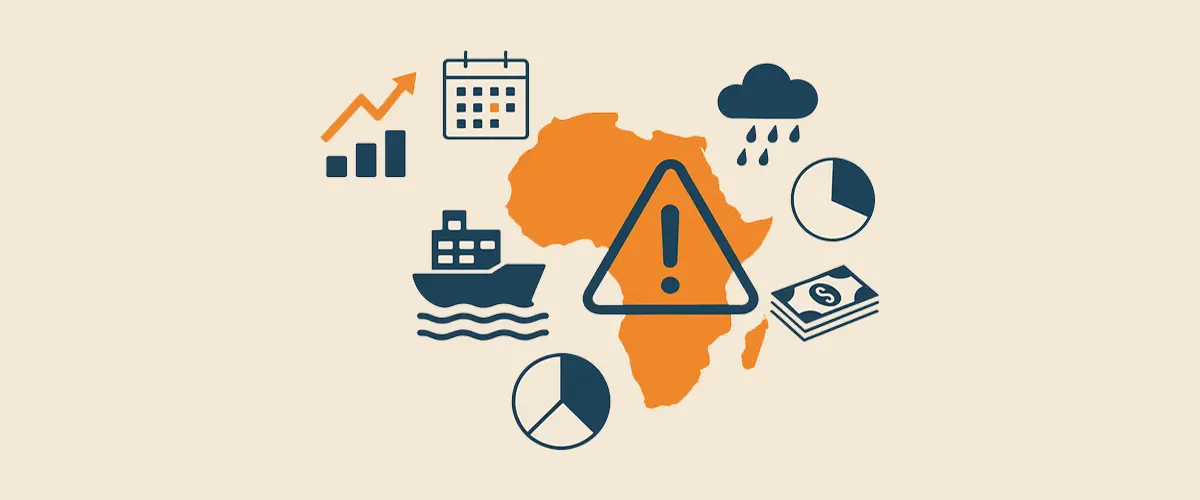
In trade, risk is not an occasional visitor, it is more like a permanent neighbour.. African exporters and importers know this all too well..
One week it is a sudden tariff spike on fruit entering already established markets, the next it is an unexpected delay at a key port due hampering operations, and the following month it is the currency swinging wildly against the dollar..
Each incident threatens profit margins, but each also teaches us something: risk is not just a threat, it is a teacher..
The question is, are we listening..??
The African flavour of risk
Every trading bloc faces risk, but Africa’s landscape makes it sharper and sometimes more complex:
- Tariff surprises: From EU’s sanitary regulations on agricultural exports from certain African countries, to unexpected restrictions or trade bans introduced by countries, tariffs and duties can change overnight and reshape entire value chains
- Fraudulent paperwork: Fake trade documents like certificates of origin, altered invoices, or recycled phytosanitary documents remain a real headache, eroding trust in African exporters
- Infrastructure bottlenecks: Congestion at key ports in South Africa like Durban and Cape Town or power cuts disrupting reefer storage can create knock-on delays across the continent
- Financial exposure: Many small and medium exporters extend credit to overseas buyers without strong protection, often learning the hard way about defaults while on the other hand several SMMEs are struggling to access trade finance
- Currency storms: South Africa’s rand volatility alone can turn a profitable deal into a loss within days
In other words, risk is woven into the daily fabric of African trade. Ignoring it is not an option.
The South African paradox
South Africa has some of the strongest trade infrastructure on the continent, yet exporters remain exposed. Why..?
- Customs systems are relatively advanced, but fraud still slips through.
- Ports like Durban are among the busiest in the Southern Hemisphere, but efficiency is often compromised by infrastructural inefficiencies, labour issues, congestion, or weather.
- Digital trade platforms exist, but integration across the region is fragmented.
This paradox – strong foundations yet fragile outcomes – means South Africa is both at risk and well placed to lead reform.
Turning risk into a catalyst
For Africa, and particularly South Africa, the way forward is not to hide from risk but to use it as fuel for transformation:
- Digitise everything that matters: From bills of lading to certificates of origin, electronic records reduce forgery opportunities and speed up validation.
- Build regional trust systems: AfCFTA provides the platform for trade, but countries must share databases of certificates and risk profiles. Fraud thrives in silos.
- Support SMEs with affordable tools: The bulk of exporters are small players. Grants, shared platforms, trade finance facilities and simplified AI-based compliance tools can close the gap.
- Invest in skills as much as in systems: AI adoption will fail without people who understand both trade and technology. Training must be prioritised.
- Scenario thinking as standard practice: Firms should regularly simulate “what if” events – what if tariffs double, what if Durban shuts for a week, what if rand plunges 20% – and prepare responses.
A continental opportunity
Risk is not evenly spread, but it is universally felt. A Kenyan flower grower, a Ghanaian cocoa exporter, and a South African citrus farmer face different versions of the same problem: unpredictability. By approaching risk as a catalyst rather than a curse, Africa can turn its vulnerabilities into a competitive edge.
South Africa, with its legal frameworks, financial markets, and relative infrastructure strength, can become the testing ground. If AI-based fraud detection, tariff forecasting, and digital documentation can work here, they can be scaled across the continent.
Where HM Business Solutions fits in
At HM Business Solutions (HMBS), we see risk not as a roadblock, but as the spark that drives smarter trade. Our advisory services help the global exporters and importers:
- Strengthen documentation and compliance through digital trade solutions.
- Assess and mitigate tariff and credit risks with structured strategies.
- Adopt digital transformation in a way that is practical, cost-effective, and scalable.
- Run “what if” scenarios so that firms are ready for disruptions before they happen.
This is where HMBS stands apart: we help businesses Simplify Trade and Amplify Success by turning complexity into clarity, and uncertainty into opportunity.
Closing thoughts
In African trade or other trades for that matter, risk will not disappear. Fraudsters will innovate, tariffs will shift, currencies will wobble, and ships will queue at ports. But each disruption is also a reminder: risk is the sharp edge that forces us to sharpen our systems.
For South African businesses, the challenge is not whether risk will come – it will – but whether they treat it as a threat to be feared, or as a teacher to be embraced..
At HM Business Solutions, we believe that with the right advisory, digital tools, and forward-looking strategies, risk can be the very thing that helps African trade grow stronger.


Leave a Reply