

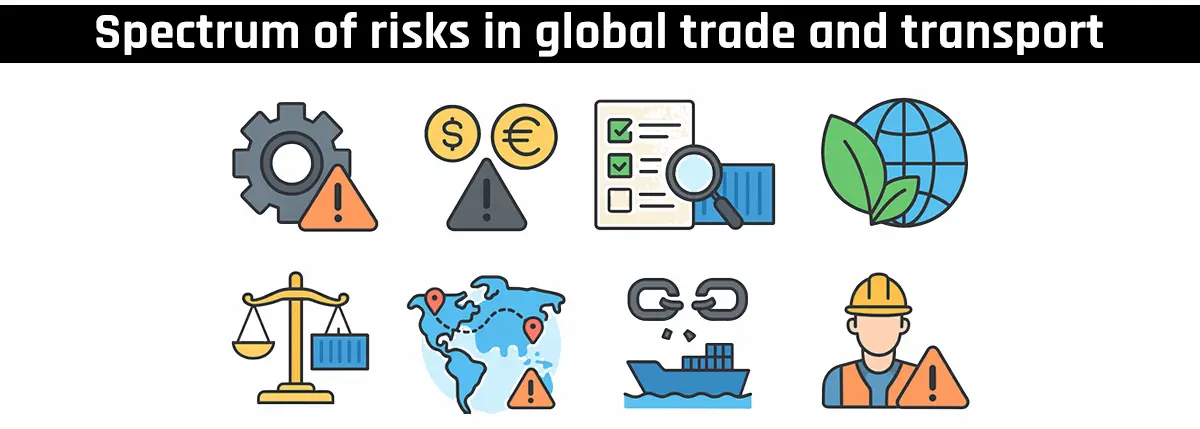
Risk is part of everyday business in global trade.. Whether you are a shipping line managing busy sea lanes, a freight forwarder coordinating multimodal cargo, or a trader balancing compliance with cash flow, risk is present at every stage.. Recognising these risks and preparing for them is essential to maintain resilience and competitiveness..
Here are the risks that anyone involved in global transport and trade should consider..
- Operational Risk
- Financial Risk
- Regulatory & Compliance Risk
- Security Risk
- Legal Risk
- Geopolitical Risk
- Technological Risk
Operational risk
Operational risk covers failures in the day-to-day processes that keep goods moving efficiently.. This includes booking errors, miscommunication between carriers and warehouses, equipment failures, and mishandling during loading or unloading..
As an example, incorrect labelling of cargo can result in it being shipped to the wrong destination, triggering claims and delivery delays.. Poor coordination of port calls or incomplete documentation can create schedule disruptions, increased port costs, and strained customer relationships..
Financial risk
Financial risk is always present in global trade, with cash flow challenges, volatile exchange rates, and fluctuating freight costs.. Payment delays or changes in demand can quickly impact working capital, particularly for small and medium businesses..
SMEs often face rejected trade finance requests, contributing to an estimated USD 2.5 trillion global trade finance gap according to the Asian Development Bank..
Rejection rates for SMEs can exceed 40%, highlighting the challenges in securing reliable financing for cross-border transactions..
Regulatory and compliance risk
Compliance with international trade regulations is critical to avoid fines, delays, and reputational damage.. Failing to comply with environmental rules like MARPOL, local cabotage laws, or sanctions can result in heavy penalties, vessel detentions, and even loss of operating licences..
Companies must comply with regulations such as IMO 2020, the EU Emissions Trading System, and local environmental standards..
Non-compliance can lead to fines, detentions, or exclusion from important markets.. Beyond regulatory requirements, there is growing pressure to demonstrate strong Environmental, Social, and Governance (ESG) practices, including responsible sourcing and fair labor standards throughout the supply chain..
Security risk
Security threats are a constant concern in global trade.. Cargo theft, pilferage, hijacking, cyberattacks, and insider fraud can disrupt operations and result in significant financial losses..
High-value or easily targeted goods moving through logistics hubs across Brazil, Mexico, the U.S., India, Germany, and South Africa face elevated risks.. Meanwhile, the increasing digitisation of supply chains has made them targets for cybercriminals who deploy ransomware attacks that can halt port operations or cripple shipping systems..
Legal risk
Contracts are the backbone of international trade, but they also create exposure to legal disputes.. Issues can arise over charter party terms, Bills of Lading conditions, or disagreements over force majeure events and performance obligations..
The adoption of electronic Bills of Lading brings new challenges around legal recognition, digital signatures, and enforceability.. Legal disputes can tie up cargo, disrupt customer relationships, and consume significant time and resources..
Geopolitical risk
Geopolitics has a direct impact on trade routes, costs, and operational certainty.. Conflicts and tensions can force carriers to reroute, add to insurance premiums, or cause significant delays..
Political instability has been identified as the biggest operational risk by ICS Maritime Barometer 2024–2025.. The other key issue currently is the continued rerouting of ships via the Cape of Good Hope to avoid the Red Sea and Suez Canal, adding weeks to transit times and increasing costs..
Red Sea disruptions have intensified.. Houthi attacks—including the sinking of Magic Seas and Eternity C—have led to the continuance of the rerouting via the Cape of Good Hope, adding 10–15 days to transit times. War risk premiums have surged from 0.3% to 1% of vessel value, adding hundreds of thousands of dollars per voyage..
The Russia–Ukraine war continues to destabilize energy and grain exports.. Ukraine’s Black Sea access remains constrained, with rerouting through Danube and Baltic corridors.. Russian attacks on port infrastructure and grain terminals have damaged over 200 facilities..
Technological risk
While technology improves efficiency, it also introduces new vulnerabilities.. System outages, poor integration between partners, and over-reliance on single platforms can create significant operational issues..
A malfunctioning Warehouse or Transport Management System can misallocate cargo, while failures in shipboard navigation or communications systems can result in accidents or delays.. Investing in robust, well-integrated technology and staff training is essential to minimise these risks..
Labour unrest, strikes at ports or customs facilities, and regulatory changes around working conditions can all disrupt cargo flows, requiring careful planning and negotiation to maintain service reliability..
Conclusion
Risk is an unavoidable part of international trade, but it can be managed effectively.. Companies that take the time to understand the full range of risks, plan carefully, and develop strong controls and partnerships are better prepared to navigate uncertainty..
This means investing in compliance, training, technology, and resilient supply chain design.. While no risk can be completely eliminated, thoughtful preparation is the foundation for building a more competitive and robust business in today’s interconnected world..
But you don’t have to do this alone.. If any of these challenges sound familiar, let us connect.. HM Business Solutions helps you uncover blind spots, strengthen operations, and build resilience where it matters most..



Leave a Reply